
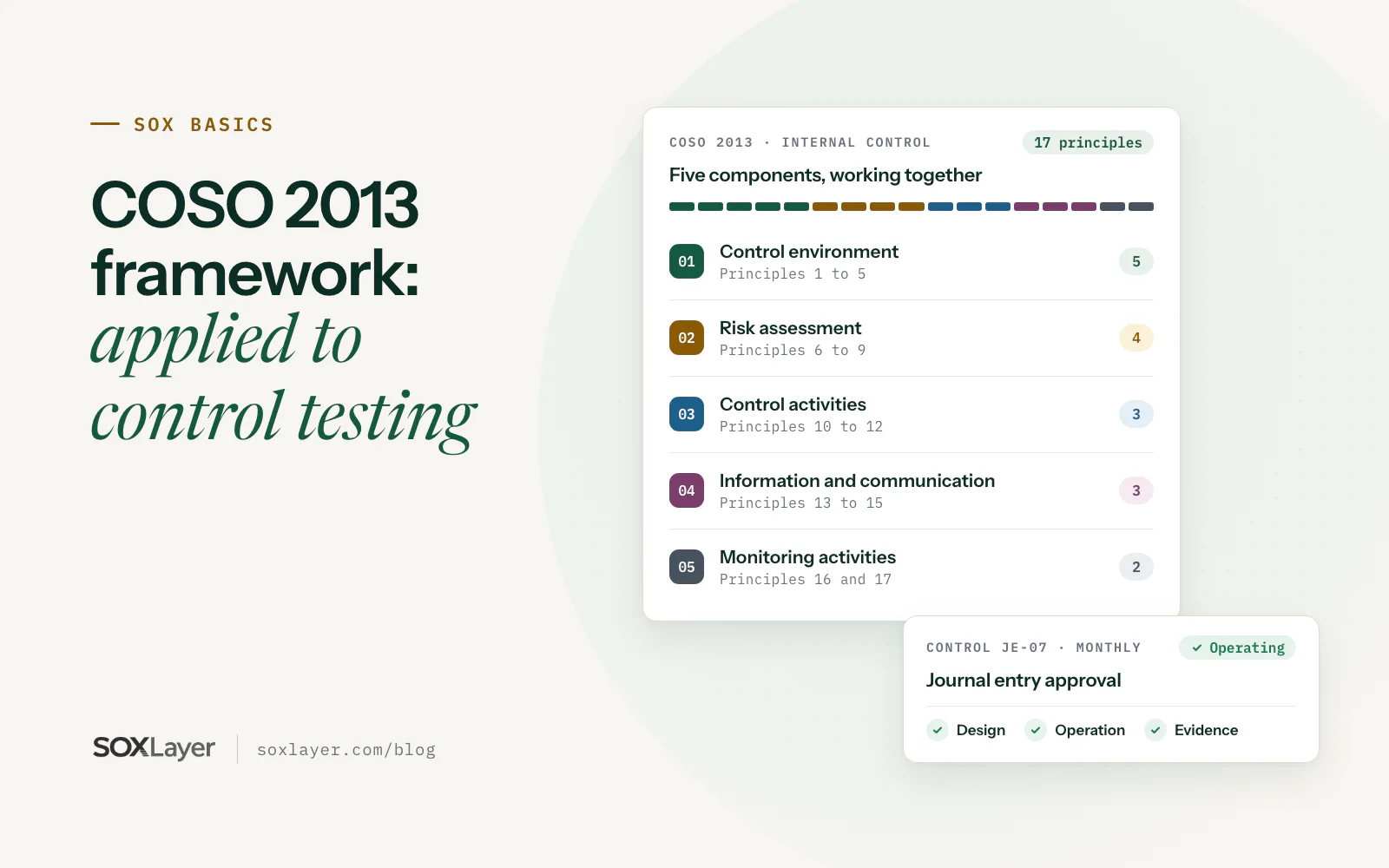
The COSO 2013 framework is the current version of the COSO internal control framework: five components and 17 principles for judging whether internal control works. In control testing, you use it to tie each control to the risk it addresses, decide what evidence proves it ran, and see what else it depends on. It does not tell you how many samples to pull or what passes. Your methodology and your auditor do that.
This guide explains the COSO framework in testing terms, including the COSO cube, then walks a seven-step way to apply it to a real control, with a payment approval running through the steps and a monthly bank reconciliation as the worked example.
The short version
- COSO 2013 has five components and 17 principles that work together, not five separate checklists
- Start every test from the risk, then use COSO to see what the control leans on
- Test design first (could it work?), then operation (did it work, all period?)
- A policy is not evidence. A dated, attributable record is
- A potential exception is investigated before anyone calls it a deficiency
What is the COSO framework? The 2013 version explained
The COSO framework is the Committee of Sponsoring Organizations' model for internal control. Its current version, the COSO 2013 framework, is formally the COSO Internal Control - Integrated Framework. It is a guide to designing and evaluating internal control. COSO published the update in May 2013. The original 1992 version was treated as superseded after December 15, 2014.
It covers three kinds of objectives: operations, reporting and compliance. SOX programs use the reporting side, specifically internal control over financial reporting (ICFR).
The structure is five components, each backed by principles, 17 in total. COSO's test for an effective system is that every component and relevant principle is present and functioning, and that the five operate together. That last part is the one teams skip. A strong approval control does not rescue a reviewer working from an incomplete report.
The 2013 update also added points of focus under each principle. They describe what a principle usually looks like in practice. They are not a checklist you must evidence one by one.
Why the COSO internal control framework matters for SOX
This is where SOX and COSO meet. Section 404 of the Sarbanes-Oxley Act requires management to assess ICFR every year, and SEC rules require that assessment to use a suitable, recognized control framework. The COSO framework of internal control is the one most US public companies name in their report. Your external auditor then evaluates ICFR against the same framework under PCAOB AS 2201.
So COSO is the yardstick for the overall conclusion. Control testing is how you gather the evidence to use it. For a journal entry approval control, COSO helps you name the risk (unauthorized entries), shape the control (approval before posting) and decide what proves it ran (an approval record with a name, a role and a date).
If testing itself is new to your team, SOX testing 101 covers the RCM-to-sign-off basics this post builds on.
The 5 COSO components and the COSO cube
The five components of COSO are usually drawn as the COSO cube: objectives across the top, components down the front, and the parts of the organization along the side.
How to read the COSO cube
- Top
- Three objectives: operations, reporting and compliance. SOX lives in the reporting column.
- Front
- The 5 COSO components, from control environment down to monitoring activities.
- Side
- Where control operates: entity, division, operating unit and function.
Every component applies to every objective at every level. That is the cube's whole argument, drawn in three dimensions.
In testing terms, each component answers a different question about a control. Pick one below to see its principles, what a tester checks and the evidence to ask for.
1. Control environment
The tone, structure and accountability every other control sits on: who has authority, who answers for what, and whether people take it seriously.
Principles
- 1Commitment to integrity and ethical values
- 2Board oversight, independent of management
- 3Structure, reporting lines, authority and responsibility
- 4Commitment to competence
- 5People held accountable for internal control
What a tester checks
- Control responsibilities are assigned to a named role
- The approver had the authority they used
- Control owners know what they are meant to do
Evidence to ask for
- Delegation of authority matrix
- Role descriptions, org chart
ExampleManagers approve journal entries above a set amount. The delegation of authority should say who may approve, and up to how much.
2. Risk assessment
How the company finds and weighs what could stop it meeting its objectives, including fraud and change.
Principles
- 6Objectives clear enough to identify risks
- 7Risks identified and analyzed
- 8Fraud risk considered
- 9Significant changes identified and assessed
What a tester checks
- The risk the control is meant to address
- What could go wrong if it fails
- Whether a new system or process changed that
Evidence to ask for
- RCM risk statements
- Fraud risk assessment, change log
ExampleIf the risk is unauthorized journal entries, test the controls over preparing, approving and posting them, not only the approval.
3. Control activities
The approvals, reconciliations, reviews and access restrictions that reduce risk. The most visible part of any test.
Principles
- 10Control activities chosen to reduce risks
- 11General controls over technology
- 12Policies, and procedures that put them into action
What a tester checks
- The control is designed to catch the risk
- The right person did it, at the right time
- It ran for every sampled instance
Evidence to ask for
- Signed reconciliations, approval logs
- System configuration, access lists
ExampleA finance manager approves the monthly bank reconciliation. The tester checks the reconciliation, the review evidence, the approval date and follow-up on differences.
4. Information and communication
Whether people performing controls have complete, reliable information, and whether issues reach the people who need to act.
Principles
- 13Relevant, quality information is used
- 14Internal communication about internal control
- 15Communication with outside parties
What a tester checks
- Reports the control relies on are complete and accurate
- Problems are escalated to the right people
Evidence to ask for
- Report parameters and a tie-out to the ledger
- Escalation emails or tickets
ExampleA reconciliation reviewer relies on the bank statement and a ledger report. If either is incomplete, the review is only as good as the missing rows.
5. Monitoring activities
How the company finds out whether its controls are still working, and what it does when they are not.
Principles
- 16Ongoing and separate evaluations
- 17Deficiencies evaluated and communicated in time
What a tester checks
- Issues were reported, assigned and corrected
- Fixes were retested before anyone relied on them
Evidence to ask for
- Deficiency log, remediation plans
- Internal audit reports, retest results
ExampleA monthly reconciliation review was missed. The company should record it, assess the impact and decide whether corrective action is needed.
The 17 principles of the COSO Internal Control - Integrated Framework
The 17 COSO principles turn each component into something you can evaluate. Here is where they sit and what a tester considers for each group.
| Component and principles | What testers consider |
|---|---|
| Control environment Principles 1 to 5 | Ethics, oversight, authority, competence, accountability |
| Risk assessment Principles 6 to 9 | Objectives, risks, fraud risk, significant change |
| Control activities Principles 10 to 12 | Risk-reducing controls, technology controls, policies |
| Information and communication Principles 13 to 15 | Quality information, internal and external communication |
| Monitoring activities Principles 16 and 17 | Ongoing evaluations, communicating deficiencies |
The principles frame the assessment. They do not replace understanding the specific control, its risk and the evidence it needs. A useful program connects each relevant principle to a real process and a real control, not to a slide.
COSO internal control in practice: 7 steps to test a control
Here is how to apply the COSO framework to a single control, which is where COSO control testing actually happens. The running example is a payment approval control: an authorized manager approves each payment before it is released. Each step shows the COSO component it leans on most.
-
01
Risk assessment
Understand the control objective
Start with what the control is supposed to achieve. Four questions get you there:
Ask first4
- What risk does it address?
- What could go wrong?
- Does it prevent or detect?
- Who performs it?
For the payment approval, the risk is an unauthorized payment, and the control is meant to prevent it. Read the approval rules before you open a single payment record.
-
02
All five
Map it to the relevant components and principles
The payment approval sits in control activities (principle 10). It also depends on the control environment for approval authority, on information for an accurate payment run, and on monitoring for what happens when an approval is missed.
Do not force each control into one box. COSO has 17 principles, and no single control needs to be filed under all of them. Most lean on two or three.
-
03
Control activities
Assess design effectiveness
Design asks whether the control, done as described, could stop or catch the risk.
Design check5
- A clear purpose
- A named performer
- Happens at the right time
- Precise enough for the risk
- Leaves evidence behind
Timing is where this example breaks. If the manager approves after the payment is released, the control cannot prevent an unauthorized payment, however neat the approvals look.
-
04
Control activities
Test operating effectiveness
Operation asks whether the control actually ran, as designed, across the period. Select instances using your methodology (the sample size guide has illustrative ranges by frequency) and inspect each one.
Evidence per sampled payment5
- The payment record
- The approval workflow entry
- The approver's identity and role
- The approval date
- Any exception or follow-up
Compare each item to the control's requirements. A policy alone does not prove the control operated.
-
05
Information and communication
Evaluate the evidence
Control testing is only as good as the evidence behind it. Run each item through four questions:
Is the evidence
- RelevantTied to this control and this period
- CompleteNothing important missing
- ReliableFrom a source you can trust
- ClearAnother reviewer can see what it shows
If the answer to any of them is no, ask for clarification or more support before you conclude. Evidence that arrives as a screenshot of a screenshot usually needs a second request.
-
06
Monitoring activities
Record exceptions and assess their impact
When a control did not operate as required, write down what happened, which requirement was missed, the evidence that shows it and whether it could affect financial reporting.
Potential first, confirmed second
A late approval might be a timing exception, a second approval record you have not seen yet, or a misread date. Investigate before you call it a deficiency. Confirmed ones then need a severity call, which the deficiency classification guide walks through.
-
07
Monitoring activities
Document the conclusion
The workpaper should let another qualified reviewer follow the work without redoing it.
The workpaper states6
- The control and the risk
- Period and population or sample
- Procedures performed
- Evidence reviewed
- Exceptions found
- The conclusion and why
Start your 14-day free trial
Bring one control and its evidence. The trial includes 5 AI sample tests and 50 manual ones, no card needed.
Worked example: a COSO audit test of a monthly bank reconciliation
This is the kind of test internal audit or your external auditor runs when they audit COSO-based controls. The control: a finance manager reviews and approves each month's bank reconciliation. Its objective is to find and resolve differences between the bank statement and the general ledger.
It sits mainly in control activities. It also depends on reliable information (the statement and the ledger report) and on monitoring (what happens when a review is missed). Applied step by step:
- Understand the risk. Unreconciled or wrong cash balances could misstate the financial statements.
- Review the design. Confirm the reconciliation is prepared, reviewed and approved by the required people, before the close deadline.
- Select the months. Pick instances from the period under review using your methodology. For a monthly control that is often 2 to 5 (illustrative; your auditor's minimums win).
- Inspect the evidence. The reconciliation, its support, the approval and the explanations for reconciling items.
- Check performance. Confirm the review and approval happened as required, by the right person, on time.
- Investigate exceptions. Follow up any missing approval or any material difference nobody explained.
- Document the result. Record the evidence and say whether the control operated as intended, and why.
Workpaper summary · illustrativeCTRL-BR-01
- Risk
- Cash misstated through unreconciled differences
- COSO
- Control activitiesInformationMonitoring
- Sample
- Selected months from the period, per methodology
- Evidence
- Reconciliation, bank statement, ledger report tie-out, approval with date
- Conclusion
- Operated as intended, or the exception and its impact, with the reason either way
The useful tag is the middle one. Information and communication reminds you to test the ledger report the reviewer relied on, not only the reviewer's signature.
COSO in accounting: how the framework relates to SOX testing
People search "COSO vs SOX", but they are not rivals. They are related, not the same. COSO is the framework for evaluating internal control. SOX control testing is the set of procedures that shows whether specific controls are designed and operating effectively.
| Term | What it means |
|---|---|
| COSO 2013 framework | A framework for designing and evaluating internal control |
| SOX control testing | Procedures that assess controls relevant to financial reporting |
| Design effectiveness | Whether a control could address its risk, done as described |
| Operating effectiveness | Whether it actually ran as intended, all period |
| Control deficiency | A weakness in a control's design or operation |
| Audit evidence | The information that supports a testing conclusion |
In accounting and financial reporting, the COSO framework and SOX work as a pair: SOX sets the obligation, COSO sets the yardstick. A company can use COSO to organize its whole assessment. It still has to decide which controls are relevant, how to test them and what evidence supports each conclusion. Timing matters too: interim and roll-forward testing covers how to spread that work across the year.
Common mistakes when applying the COSO framework
- Treating COSO as a checklist. Ticking 17 principles proves nothing about whether controls work. Real processes and real evidence do.
- Testing the policy instead of the control. A policy is a very confident document. It says what should happen, not what did.
- Losing the risk behind the control. A signature exists, but was the approval timely, and by someone authorized? Test the purpose, not the ink.
- Accepting weak evidence. If it does not support the specific testing criteria, ask for more before you conclude.
- Dropping exceptions. A missed step noted and forgotten is a monitoring failure of its own. Assess it, size it and decide the response.
Rule of thumb: start from the risk, not from principle 1
Working through the framework from the top produces mapping exercises. Working back from a risk produces tests. Pick the risk, find the control that addresses it, then ask COSO what that control depends on: authority, information, monitoring. Those dependencies are where the surprising exceptions live.
And keep the mapping light. If mapping a control to principles took longer than testing it, the mapping has stopped helping.
Where SOXLayer fits with the COSO framework
SOXLayer is SOX compliance software for planning, performing, reviewing and evidencing control tests. For COSO work specifically:
- COSO 2013 coverage (beta). Each entity is scored against the 17 principles as Covered, Partial or Gap. Some principles are evidenced by the workflow itself, such as owners, scoping, fraud risk and classified deficiencies. Others need an approved control mapped, with mappings suggested from the control's wording. Every gap becomes an owned, dated action.
- Risks mapped to controls in a versioned RCM, so each test starts from its risk.
- Tests in fixed steps: population, sampling, evidence, test attributes, conclusion, review and approval.
- An AI first pass with citations. For each sample, the AI proposes Pass, Fail, Insufficient or N/A with the exact quote and page it relied on. AI never submits, reviews or approves a test. See how AI testing works.
- Deficiencies raised from exceptions and classified, with remediation tracked to close.
- A hash-chained audit trail of who did what, when and why.
What it will not do: judge whether your board's oversight is effective or whether the tone at the top is real. Those principles need people, and evidence that mostly lives outside any testing tool.
Whatever you evaluate, ask the same questions of it: can you see each control's objective, tie evidence to the control and period, record procedures and exceptions, and let a reviewer follow the conclusion? Check those on your own controls, not in a demo. The free trial is $0 for 14 days with no card, and the pricing page lists the rest.
COSO framework FAQ
What is the COSO 2013 framework?
It is COSO's Internal Control - Integrated Framework, updated in 2013, for designing and evaluating internal control. It has five components and 17 principles, and SOX programs use it to assess internal control over financial reporting.
How is COSO used in SOX control testing?
Teams use it to tie each control to its risk, assess its design and organize the evaluation of whether it operated. The testing itself still needs suitable procedures, samples and evidence.
What are the five COSO components?
Control environment, risk assessment, control activities, information and communication, and monitoring activities.
How many principles are in COSO 2013?
Seventeen. Control environment has principles 1 to 5, risk assessment 6 to 9, control activities 10 to 12, information and communication 13 to 15, and monitoring activities 16 and 17.
Does COSO require every control to be tested?
No. COSO is a framework for evaluating internal control. Your risk assessment, compliance obligations and testing methodology decide which controls are tested and how.
What is the difference between design and operating effectiveness?
Design effectiveness asks whether a control, done as described, could address its risk. Operating effectiveness asks whether it was actually performed as intended during the period tested.
Can COSO help identify control deficiencies?
Yes. Applying it can surface weaknesses in a control's design, its performance, the information it relies on or how it is monitored. The company then has to evaluate and fix what it finds.
What is the COSO cube?
It is the diagram COSO uses for the framework. The top shows the three objectives (operations, reporting, compliance), the front shows the five components, and the side shows entity levels from the whole entity down to a single function.
Is the COSO ERM framework the same as the COSO internal control framework?
No. COSO's Enterprise Risk Management framework, last updated in 2017, covers how an organization manages risk alongside strategy and performance. SOX programs assess ICFR against the 2013 internal control framework, which is the one this guide covers.
Is the 1992 COSO framework still used?
COSO treated the 1992 framework as superseded after December 15, 2014. SOX programs that name COSO now use the 2013 version.
Sources and further reading
The documents behind this article. Your external auditor's methodology and your own policies still set the requirements for your program.
- COSO, Internal Control - Integrated Framework: the framework itself and COSO's supporting guidance
- SEC Release 33-8810: interpretive guidance for management's evaluation of ICFR
- PCAOB AS 2201, An Audit of Internal Control Over Financial Reporting: the auditor's standard, which uses the same framework as management
Five components, 17 principles, and still one control at a time.

Read these next
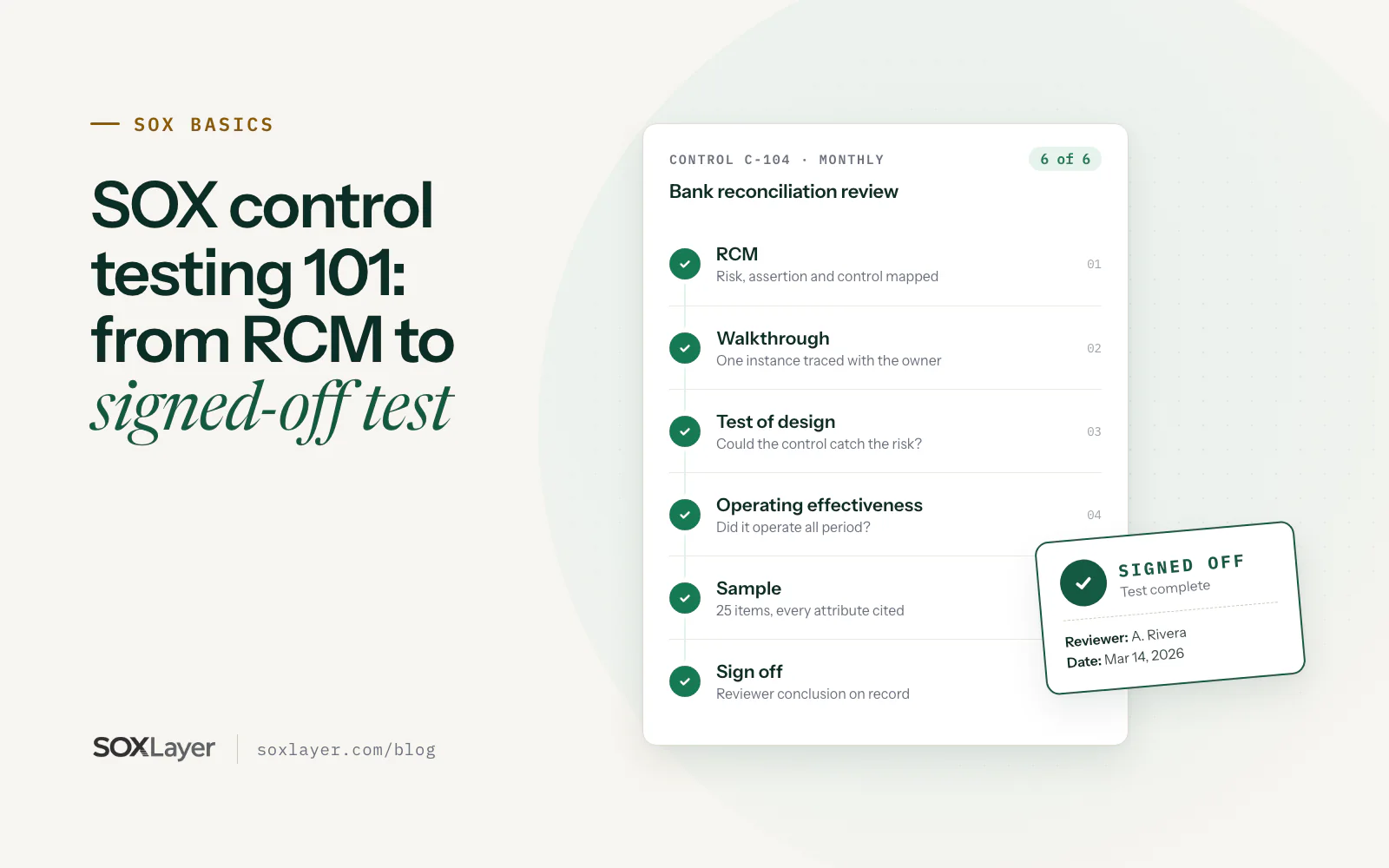
SOX testing 101: how to test SOX controls, from RCM to sign-off
Seven steps from RCM row to signed-off test, with a worked bank reconciliation control description and a checklist for a test file that stands on its own.
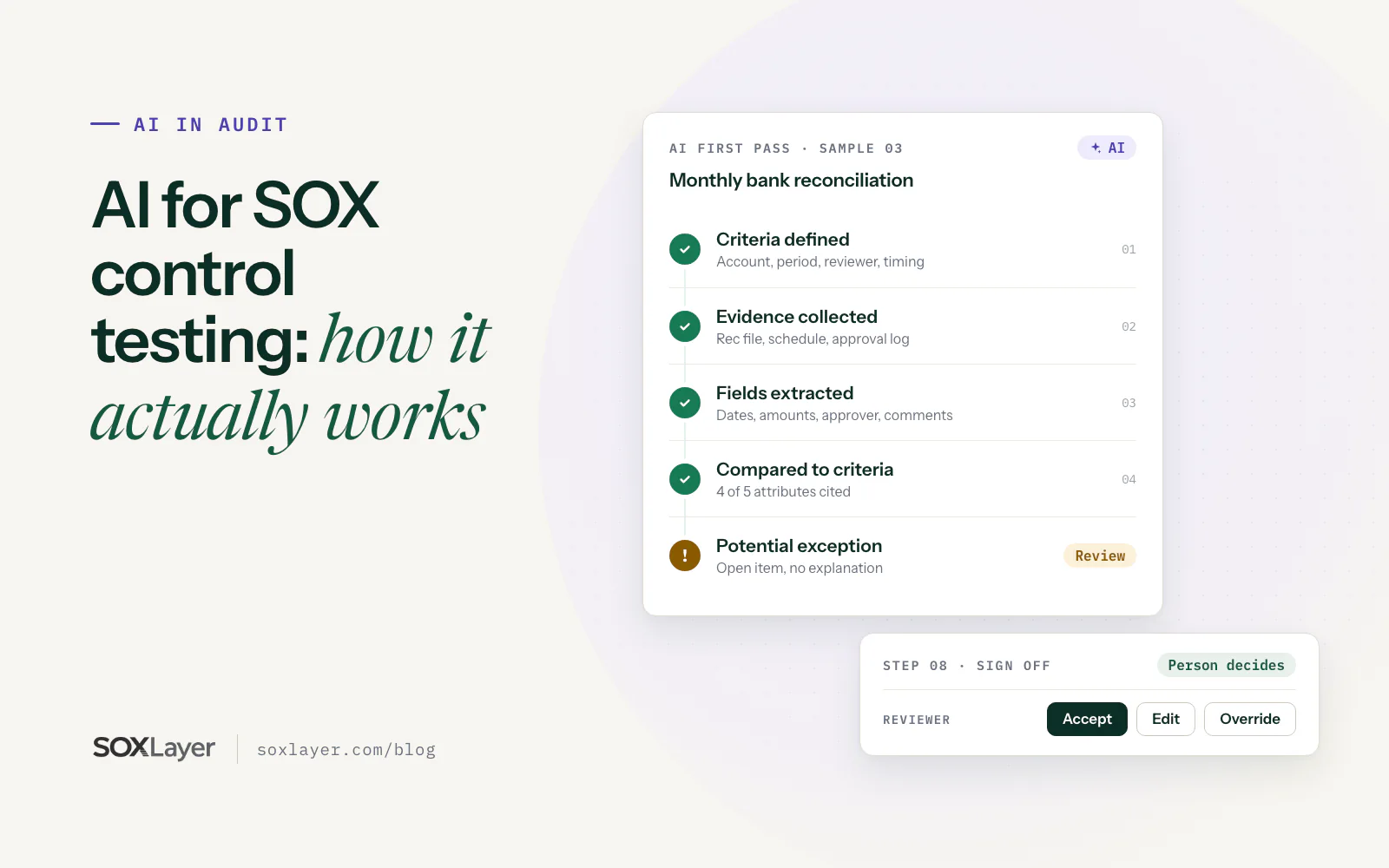
AI for SOX control testing: how it actually works
Eight steps from control criteria to signed-off workpaper, what AI takes off a tester's plate, when it isn't worth it, and what it costs.
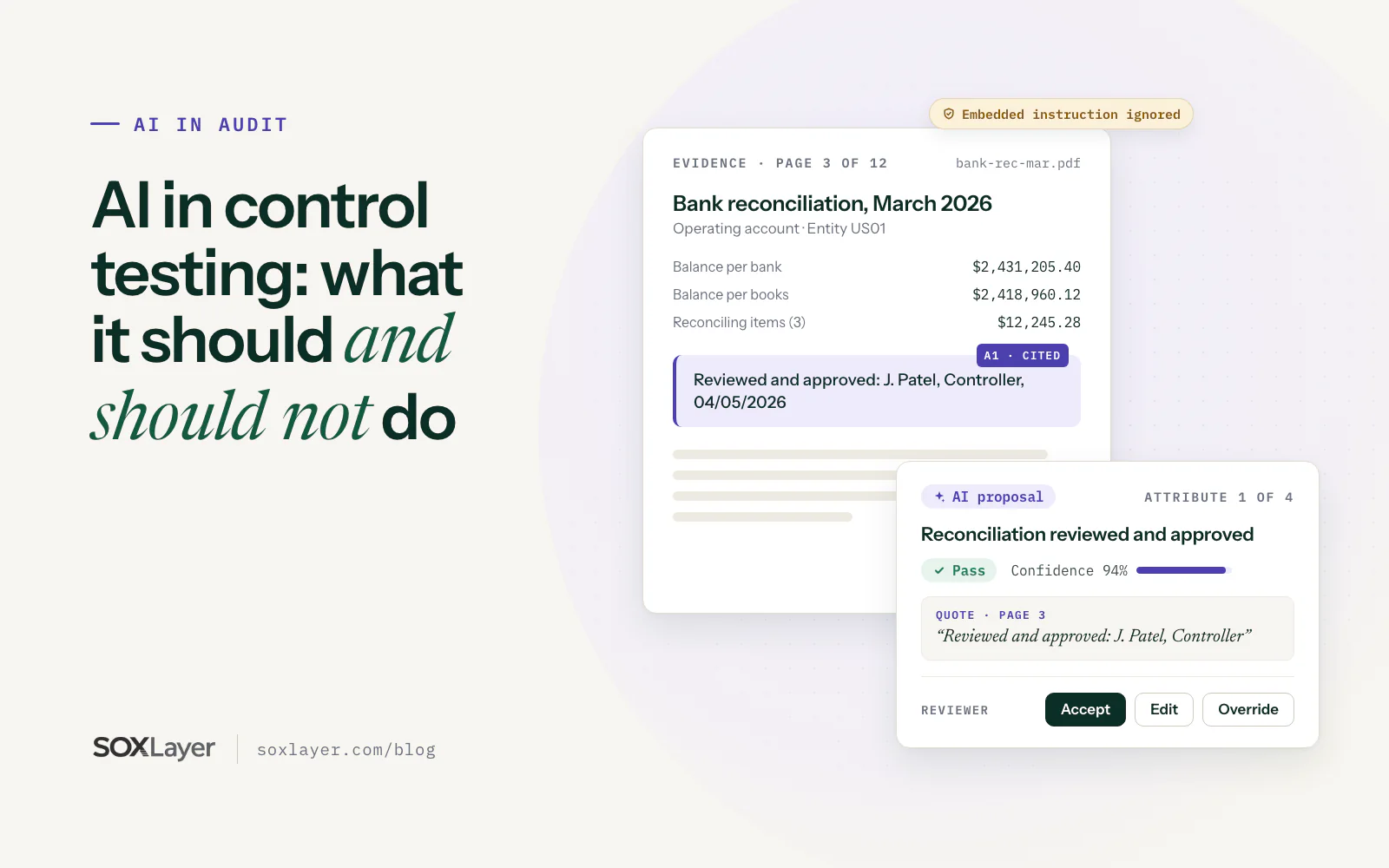
AI in auditing: what it should and should not do in control testing
Why every AI verdict in SOX testing needs a quoted line and page, and why AI should never sign off a test, even when it is sure.