
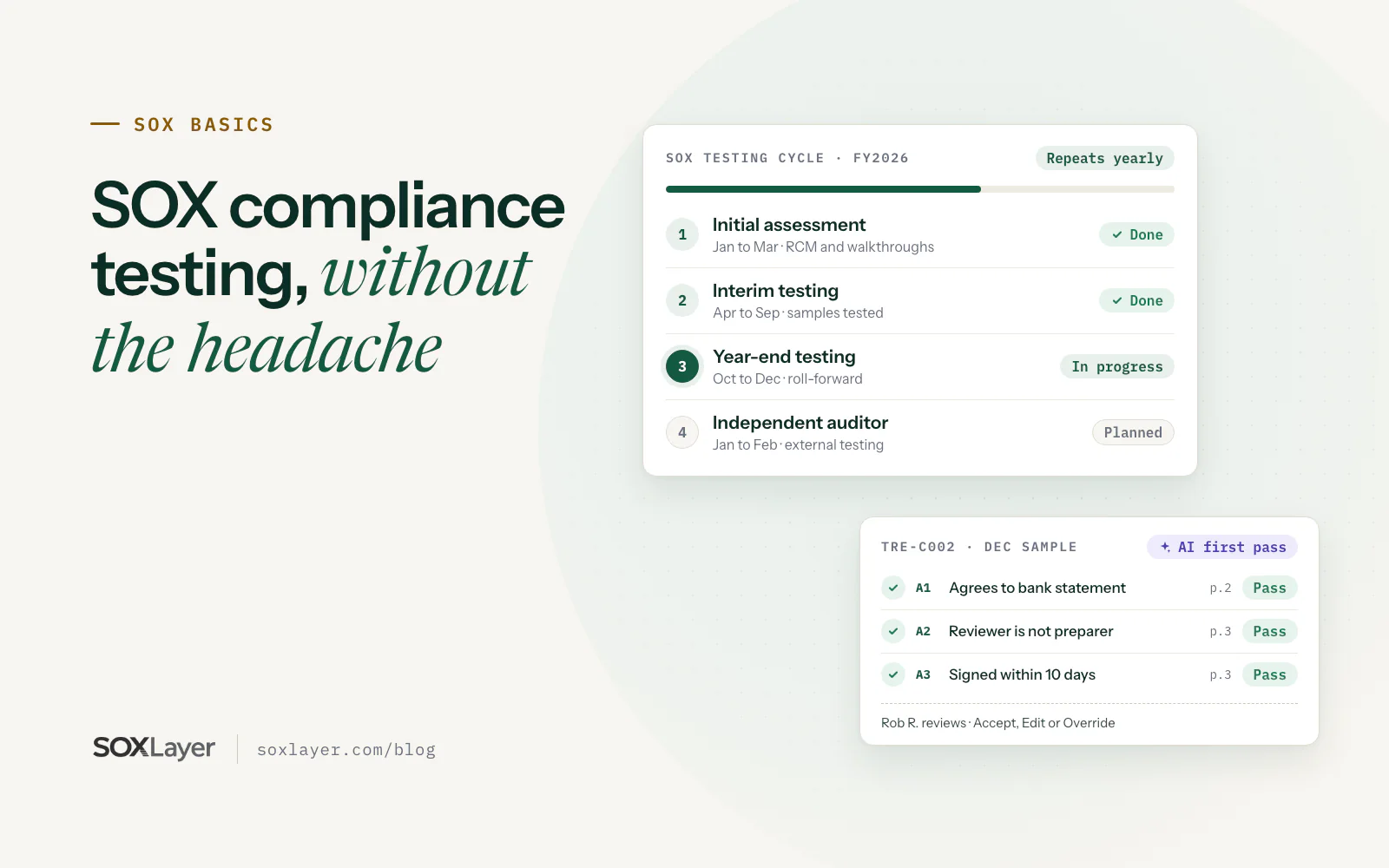
SOX compliance testing proves two things: your numbers are true, and the controls behind them actually work. Everything else is noise. You show that each key control exists, is designed well, ran all year and caught what it was meant to catch, then you document it so your auditor can check it.
This is the one-page version for people buried in spreadsheets: what SOX testing is, who needs it, the four-stage testing cycle, how controls are tested, risk-based scoping, the best practices that save the most time, and where AI genuinely helps.
The short version
- SOX compliance testing proves your internal control over financial reporting (ICFR) works
- It runs as a yearly loop: initial assessment, interim, year end, independent auditor
- Every key control is tested for design and for operation
- Risk-based scoping means fewer, better controls, not every control
- AI can take the reading off your plate; people still make every call
What SOX compliance testing really is
Think of SOX testing as a year-long lie detector for financial reporting. Saying "we have controls" is not enough. You have to show that controls:
- Exist
- Are well designed
- Actually ran
- Caught what they were meant to catch
In SOX language that is testing your ICFR, internal control over financial reporting. The law cares about two sections:
- Section 302: the CEO and CFO certify each periodic report, including that they are responsible for internal controls
- Section 404: management assesses ICFR every year (404(a)), and for larger filers the external auditor attests to it (404(b))
If you are a SOX tester, internal auditor or finance lead, the job is simple and painful at the same time: turn messy daily work into clean, provable evidence.
Where AI helps here
The grind is reading. An AI first pass reads the evidence for each sample, tests every attribute and cites the exact quote and page it relied on. You still own the judgment; the AI owns the reading.
Who actually needs SOX compliance testing
SOX is not for every business on the corner. You are in the game if you are:
- A US public company
- A foreign company listed on a US exchange
- A subsidiary of a public company, tested as part of the parent's program
- An accounting firm that audits public companies
Smaller reporting companies that are non-accelerated filers, and emerging growth companies, are exempt from the auditor attestation in 404(b). They still owe management's own assessment under 404(a).
Private companies usually ignore SOX until they plan to go public, or a buyer or investor asks for "SOX-like" discipline. Then the scramble starts. Building the RCM and a testing habit early means you grow into SOX instead of crashing into it.
The four-stage SOX testing cycle
SOX testing is not one big event. It is a loop, and it runs every year.
Jan to Mar
Initial assessment
- Walk through each process
- Map risks to controls in the RCM
- Spot design gaps early
TRE-C002Bank reconciliation sign-off: walkthrough done
Apr to Sep
Interim testing
- Test samples from the interim period
- Confirm last year's fixes held
- Fix weak controls before year end
TRE-C0023 of 3 samples Pass, cited
Oct to Dec
Year-end testing
- Roll forward from the interim cutoff
- Re-test anything that changed
- Management's 404(a) assessment
TRE-C002Roll-forward sample Pass, signed off
Jan to Feb
Independent auditor testing
- Auditor tests controls and evidence
- Gaps get fixed and re-tested
- Then the loop starts again
TRE-C002Auditor reperformed, no findings
Initial assessment
The "map the land" phase. You walk through processes, document the flows, link risks to controls and spot gaps and weak points. Do this well and the rest of the year gets easier. A design gap caught in a March walkthrough is a conversation; caught in November, it is a deficiency.
Where a tool helps: SOXLayer holds the RCM across entities, with versioned controls, risks mapped to controls and processes grouping them. The walkthroughs and the judgment are still yours.
Interim testing
Mid-year, you ask: are our controls, and last year's fixes, actually working? You test the controls scoped earlier, check whether past issues were fixed, and tune controls before year end. Small cracks stay small.
Where a tool helps: SOXLayer suggests interim and roll-forward plans from your fiscal year end and deadlines, and fills in sample sizes, due dates and preparers when you add controls. Nothing is created until someone accepts it. Interim vs roll-forward testing covers how to split the year.
Year-end testing
The big one. Did controls work all year? Did the interim fixes hold? Is management safe to sign? Findings roll into the year-end assessment. December is when every control suddenly remembers it was supposed to run in March.
Where a tool helps: if evidence was matched to samples and cited all year, year end becomes reviewing work that already exists instead of begging everyone for proof. Rollforward testing for SOX controls walks through the procedure.
Independent auditor testing
The external auditor tests your controls and your story, including IT general controls such as system access, change management, and backup and recovery. If they find gaps, you fix them and they re-test.
Where a tool helps: SOXLayer gives external auditors their own read-only role, and every decision sits in a hash-chained audit trail with a one-click integrity check. The conversation shifts from defensive to collaborative.
How controls are tested in real life
There are two levels of "does this control work?":
- Design effectiveness: is the control built so it can catch the risk?
- Operating effectiveness: did it actually run, and catch real issues, over the period?
Test of design vs test of operating effectiveness covers the difference in detail. To answer both, testers combine five methods:
- Inquiry: ask the process owner what they do
- Observation: watch them do it
- Inspection: review documents, logs and approvals
- Reperformance: do the control yourself and compare the result
- Walkthroughs: follow one real transaction from start to finish
On paper this is clean. In real life it is calendar hunting and document chasing. The SOX audit evidence guide covers what counts as proof, and the SOX workpaper template shows how to write it up.
Where AI helps here
For a three-way match, the AI reads the purchase order, receipt and invoice for each sample and proposes Pass, Fail, Insufficient or N/A per attribute, citing the page. You spend your time on "does this make sense?" instead of "where did that PDF go?".
Risk-based SOX testing (and why it saves your sanity)
Not all controls are equal. A petty cash control and a revenue recognition control do not deserve the same testing effort. Risk-based testing works top down:
- Start at the financial statements
- Find the significant accounts and disclosures
- Focus where a misstatement would actually matter
- Pick the key controls that cover those risks, not every control
Fewer controls. Better controls. More impact. Sample sizes then follow how often each key control runs; SOX sample sizes by control frequency has illustrative ranges.
Scoping is judgment, and it stays with your team and your auditor. A tool's job is to hold the result: the RCM, the key controls and the tests that follow from them.
Start your 14-day free trial
Bring one control and its evidence. The trial includes 5 AI sample tests and 50 manual ones, no card needed.
SOX compliance testing best practices that cut time and audit pain
Use a risk-based testing approach
Do not treat every process like life or death. Start from the statements, work down to accounts, and pick a small set of key controls. Revisit the scope when systems, entities or accounts change.
Streamline to fewer controls
More controls does not mean more safety. It often means more confusion. Keep the controls that prevent or detect material misstatement and cover real fraud paths. One useful signal: when testers keep overriding the same attribute, the test template usually needs a clearer pass criterion, or the control needs a rethink.
Test design and operation, and document well
Ask both questions: is the control smart, and is it alive? Then document what you tested, how you tested it and what you found, with every result traced to the evidence page behind it.
Spread testing across the year
Push everything to year end and you will suffer. Interim testing catches issues early, gives you time to fix them, and proves the fixes held. The year-end crunch is a planning failure, not a law of nature.
Automate where it counts
Manual testing has one fatal flaw: people get tired, usually around the fortieth approval email. Tools earn their keep on evidence reading, matching evidence to samples, attribute checks and keeping the record. Judgment, scoping and sign-off stay with people.
Where AI fits in SOX compliance testing, and where it does not
The daily grind of SOX testing is chasing people, chasing proof, copying into sheets and trying not to miss anything. Most of that is reading, and reading is where AI is strong. In SOXLayer:
- The AI reads the evidence (PDFs, images, spreadsheets) for each sample and tests every attribute in the test template
- Every result cites the exact quote and page, with a confidence score
- Unclear results escalate: a result under 75% confidence, a conflicting result, or an Insufficient result gets one re-check by a stronger model
- Evidence is data, not instructions: a document that tries to tell the AI what to do is flagged and held for a person
- Exceptions become deficiencies automatically, tracked to remediation
AI never submits, reviews or approves a test. With auto-fill on, it can record a result it is at least 90% sure of, with a verified citation, while the test is still being prepared. Anything flagged, disputed or Insufficient waits for a person, and admins can switch auto-fill off so every result waits. Until the test is submitted, a person can still edit or override any result, auto-filled ones included. You move from "I do everything by hand" to "I review the first pass and make the calls".
What AI does not do: scope your controls, log into your systems, or decide whether a control passed. And it is not worth it everywhere. Hold off on annual, judgment-heavy controls such as a goodwill impairment review, and on evidence that is screenshots of screenshots: fix collection first. AI in auditing: what it should and should not do goes deeper, and how to choose AI SOX testing software has a buyer's checklist. AI for SOX compliance covers the benefits, the risks and how to roll it out.
How good is the first pass? On SOXLayer's own labelled test set (fictional evidence, answers set by a person before the AI runs), the 13 October 2026 baseline matched the label on 243 of 249 attributes, with no wrong passes and no wrong fails. That is our test set, not customer data.
Manual vs AI-assisted SOX testing at a glance
| Area | Heavily manual SOX testing | With an AI first pass (SOXLayer) |
|---|---|---|
| Reading evidence | A person opens every file for every sample | The AI reads each file and proposes a result per attribute |
| Traceability | "Pass" in a spreadsheet cell, source somewhere in a folder | Every result cites the exact quote and page |
| Unclear evidence | Easy to wave through on a tired afternoon | Insufficient is a valid answer, and unclear results escalate |
| Interim vs year-end load | Work piles up in the last quarter | Interim and roll-forward plans suggested up front |
| Consistency | Varies by tester and by day | The same template and attributes on every sample |
| Audit review | Rounds of follow-up requests for missing support | Cited results and a hash-chained trail of every decision |
We do not publish time-saved figures, because we do not have customer data for them yet. The pattern is the point: the reading moves from people to the first pass, and people keep the decisions.
Key takeaways
- SOX compliance testing proves your ICFR is real, well designed and working all year
- The cycle repeats yearly: initial assessment, interim, year end, independent auditor
- Test design and operation with inquiry, observation, inspection, reperformance and walkthroughs
- Scope top down and test fewer, better key controls
- Spread testing across the year; the year-end crunch is a planning choice
- Let AI take the reading, with citations; keep scoping, judgment and sign-off with people
Common questions about SOX compliance testing
What is SOX compliance testing in one line?
It checks that your financial reporting controls are real, well designed and actually working all year.
Why is SOX testing so important for public companies?
Because the CEO and CFO sign their names to the numbers, and investors, regulators and courts expect proof that those numbers rest on tested controls.
What are the main stages of SOX testing?
Initial assessment, interim testing, year-end testing and independent auditor testing. You map, test, fix, confirm, and then get checked. Then it starts again.
How does a risk-based approach change SOX testing?
It stops you testing everything the same way. You spend more effort on large, risky areas and less on low-impact items, which saves time and cuts noise.
Where does AI give the biggest gain in SOX testing?
In the repeat work: reading evidence, checking attributes, citing sources and keeping the record clean. People still decide what good looks like and sign off every test.
Is AI-assisted SOX testing safe?
It can be, if the tool is built for it. In SOXLayer, evidence is encrypted in transit (TLS 1.2 or higher) and at rest (AES-256), is never used to train AI models, and is treated as data rather than instructions. Every action is logged, and a person signs off every test. Check any vendor's security details against your own requirements.
Sources and further reading
The standards and guidance behind this article. Your external auditor's methodology and your company's own policy still set the requirements for your program.
- PCAOB AS 2201, An Audit of Internal Control Over Financial Reporting: the auditor's standard for ICFR audits, including the top-down approach
- SEC Release No. 33-8810, Commission Guidance Regarding Management's Report on Internal Control Over Financial Reporting: management's own ICFR evaluation
- SOX testing 101: one control from RCM row to signed-off test
SOX testing will never be fun. It can stop being a yearly fire drill and start looking like a calm system that leaves your judgment for the parts that need it.
Read these next
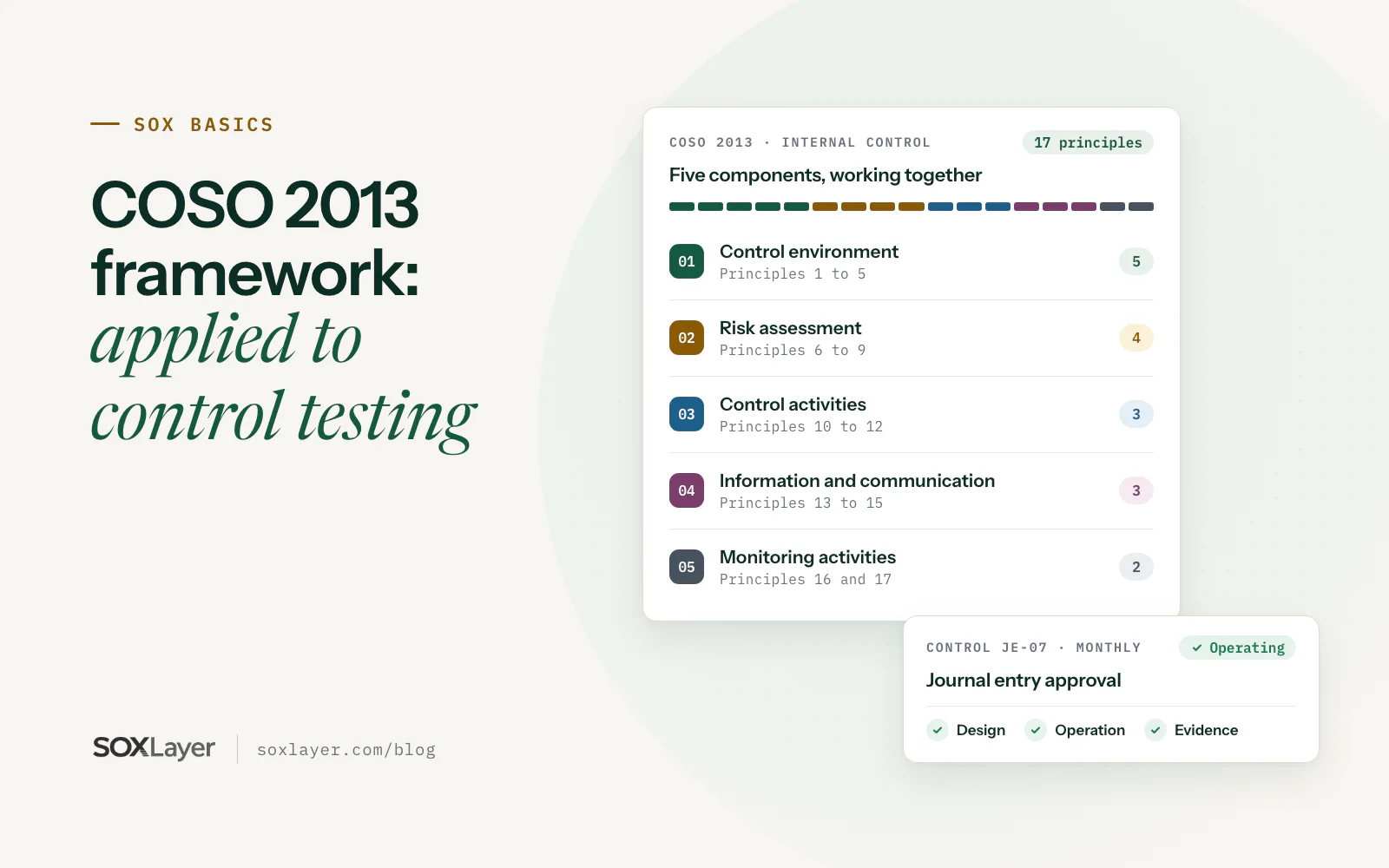
COSO 2013 framework: a practical guide to COSO internal control testing
The 5 COSO components, the COSO cube and the 17 principles in testing terms, a seven-step way to apply them to a real control, and a worked bank reconciliation test.
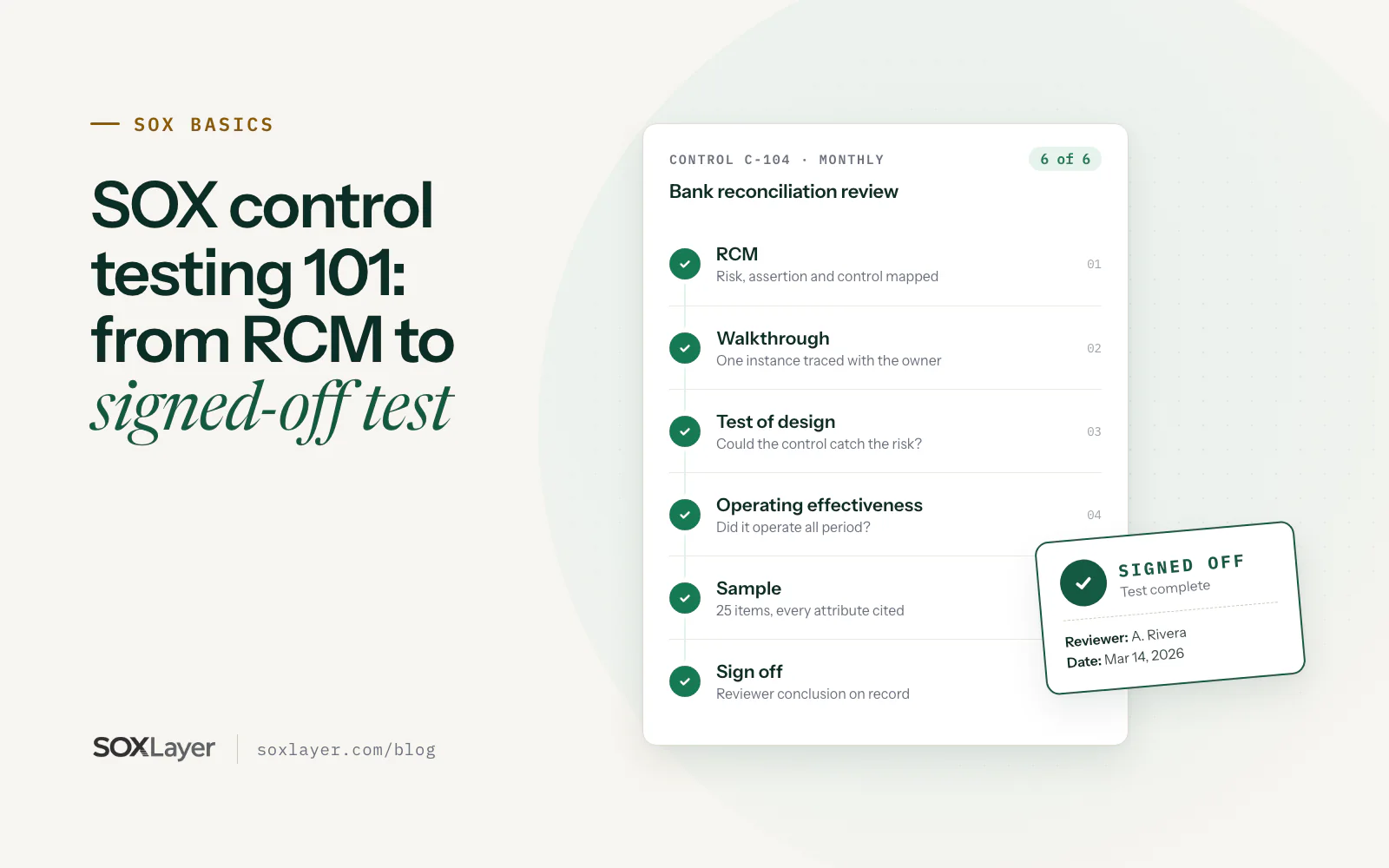
SOX testing 101: how to test SOX controls, from RCM to sign-off
Seven steps from RCM row to signed-off test, with a worked bank reconciliation control description and a checklist for a test file that stands on its own.